.svg)
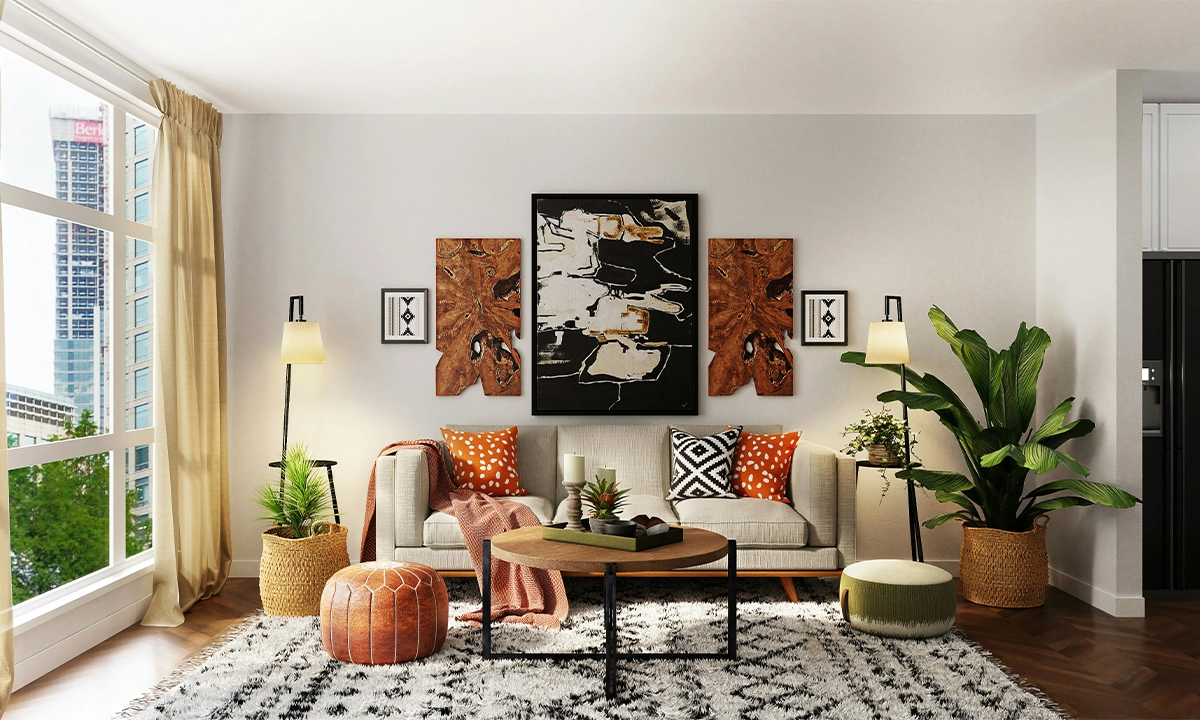
Art is often brought into a space as a finishing touch, something to tie a room together or complete a visual idea. It’s chosen to match tones, complement furniture, or sit comfortably within an existing palette. There is acertain logic to that approach, and in some cases, it works. But art chosen primarily to align with décor rarely holds attention for long.
What feels cohesive in a moment can feel incidental over time.
Should art match your décor?
Not necessarily. Art chosen solely to match a room’s color palette often loses relevance as the space changes, while work chosen for emotional connection tends to remain meaningful across environments.
Collectors who build lasting relationships with the work they live with tend to approach the decision differently. Instead of asking whether a piece fits visually, they consider whether it holds something—an idea, a memory, a tension, a feeling—that continues to reveal itself over time. The work doesn’tj ust sit in the room. It participates in it.
That participation is what creates presence.
Emotional connection is not always immediate or obvious. Some work resonates quietly. It draws attention slowly, returning in small moments rather than announcing itself all at once. This kind of connection often proves more durable than initial impact. Art that unfolds over time tends to integrate more deeply into daily life, becoming part of the rhythm of a space rather than an object within it.
This is where the distinction between decoration and meaning becomes clear.
When art is selected to match a couch, a wall color, or a design trend,i ts relevance is tied to those conditions. As the space changes, and itinevitably does, the work can lose its anchor. It becomes replaceable. In contrast, work chosen for its internal qualities—its tone, its perspective, its emotional weight—adapts. It moves with the space rather than being defined by it.
Meaning travels. Matching does not.
Why does emotional connection matter when collecting art?
Because art that resonates on a personal level continues to hold attention, adapt to changing environments, and deepen in significance over time.
There is also a subtle but important shift happening in how collectors think about ownership. Art is no longer just something to display; it is something to live with. That distinction changes the criteria. Living with a piece requires more than visual agreement. It requires a level of engagement that can sustain over time.
The strongest collections are not built on coordination. They are builton alignment—alignment between the work and the person living with it.
This does not mean that aesthetics are irrelevant. Visual harmony matters. But when harmony is driven by meaning rather than matching, it becomes more flexible. A piece that carries emotional weight can sit in different rooms, under different light, alongside different objects, and still feel right.
It doesn’t depend on perfection. It depends on connection.
How do collectors choose art that holds long-term meaning?
By looking for work that carries depth, ambiguity, and a sense of authorship—qualities that continue to reveal themselves rather than resolveimmediately.
Over time, the pieces that remain are rarely the ones that matched perfectly. They are the ones that felt necessary, even if they didn’t fully make sense at first. They are the works that continue to hold attention without demanding it, that shift slightly with each viewing, and that stay relevant even as everything around them changes.
Choosing art this way requires a different kind of patience. It asks for less certainty in the moment and more trust in what lingers afterward.
But that is often where the most meaningful work begins.
Part of an ongoing journal exploring collecting, emotion, and how artintegrates into the spaces we live in.